Fiber Cement Siding Repair in Portland: Cracks & Swelling
Can fiber cement siding be repaired? When a patch is enough, when a Hardie board must be replaced, why boards crack and swell in Portland, and what to check.
Published October 26, 2026Updated October 26, 2026
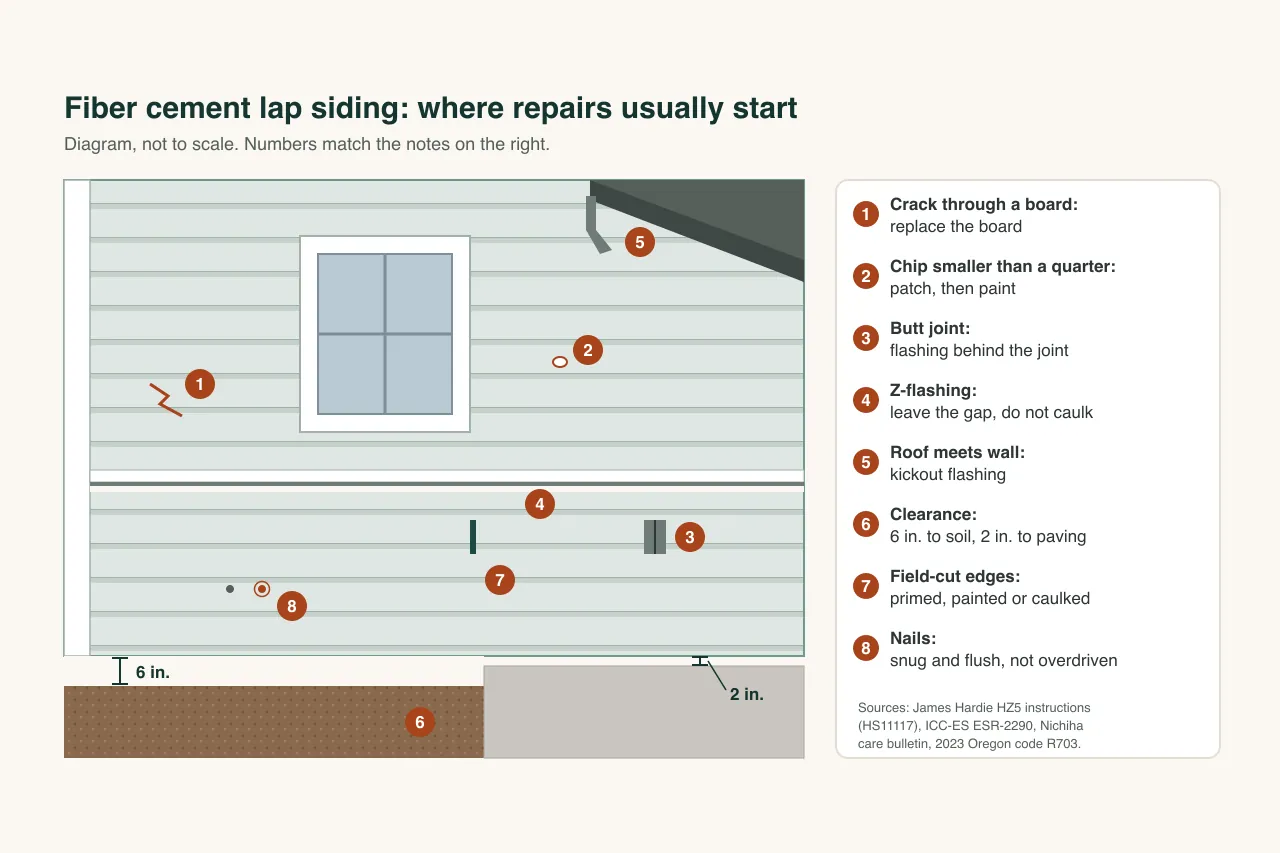
Fiber cement siding can be repaired, but only small damage is a patch job. James Hardie says small cracks, chips and dents can be filled with a cementitious patching compound. Nichiha recommends replacing any board with damage larger than a quarter. A crack through a board, a broken corner or a swollen bottom edge means a new board, and usually a look at why it happened.
The short version:
- Patch chips, dents and nail-hole-sized damage, then paint.
- Replace boards that are cracked through, broken, holed or swollen.
- Find the water before replacing a swollen board: clearances, flashing and paint are where fiber cement usually fails in a wet climate.
- Check the warranty first. James Hardie wants written notice before any permanent repair to a board you believe is defective.
This guide is about fixing existing fiber cement, most often James Hardie’s, on a Portland-area house. For choosing it as new siding, profiles and installed prices, see fiber cement (Hardie) siding.
Can fiber cement siding be repaired?
Yes, and the makers say where the line falls. The James Hardie maintenance FAQ says small cracks, chips and dents can be filled with a cementitious patching compound. Nichiha’s care and maintenance bulletin allows a quality caulk or a cementitious patch for small chips, dents and scratches. It then sets a size limit: any board or panel with damage larger than a quarter should be replaced. So should any piece that is broken, cracked or holed by an impact.
Factory-finished boards add a rule of their own. James Hardie’s HardiePlank HZ5 installation instructions (HS11117, effective September 2019) say ColorPlus touch-up should be used sparingly. Where large areas need it, they say to replace the damaged area with new boards. Hardie also says it does not warrant third-party touch-up paint on ColorPlus.
A patch is cosmetic. It closes a chip so paint can protect the board again. It does nothing for a board that is cracked through, loose on the wall or wet from behind.
Patch or replace: a decision table
Use this to sort what you see on the wall. It does not replace a look at the wall by someone who can lift a course and check the layers behind it.
| What you see | Usual fix | Why |
|---|---|---|
| A chip, dent or scratch smaller than a quarter | Cementitious patch or quality caulk, then paint | Both makers allow it for minor surface damage |
| Damage larger than a quarter, or a hole | Replace the board | Nichiha’s size limit for patching |
| A crack running through the board, or a broken corner | Replace the board | Impact breakage calls for removal and replacement |
| A gap that opened at a butt joint | Check the joint treatment; often re-set or replace the end boards | Hardie warns that boards installed wet may shrink at butt joints |
| A loose or rattling board | Refasten to the maker’s instructions | Nichiha says loose siding should be refastened |
| Cracked or shrunken caulk at trim | Remove and recaulk with a rated sealant | Both makers list recaulking as maintenance |
| White powder on the face of the boards | Wash it off, then look for water getting behind | Nichiha links efflorescence to soaked boards or unflashed openings |
| Peeling or chalky paint on sound boards | Clean, scrape loose paint, repaint with 100% acrylic | Both makers specify acrylic paint, never stain or oil |
| Soft or damaged boards on several walls | Price a partial or full re-side | Repairs stop paying when the same failure repeats |
The last row is where siding replacement starts to make more sense than board-by-board work.
Why fiber cement cracks, gaps and stains
Fiber cement does not rot, but it has edges, joints and fasteners, and that is where the makers’ warnings cluster.
Fastening. Hardie’s HZ5 instructions want every fastener driven square to the board and “snug” against it, with no air space under the head. Their fastener chart treats under-driven, over-driven and angled nails as faults, each with its own correction. Blind nailing through the top of each board is Hardie’s preferred method. Face nailing is meant for high-wind areas where code requires it, and is not to be combined with blind nailing, except under a technical bulletin covering repairs.
Butt joints. Where two board ends meet, Oregon’s residential code (2023 ORSC R703.10.2) requires the ends to be caulked, covered with an H-section joint cover or set over a strip of flashing. Hardie recommends the flashing. Its instructions also say boards installed wet or saturated may shrink at the butt joints, which is why it wants product stored flat, dry and covered.
Clearances. ICC-ES evaluation report ESR-2290 (reissued March 2026) requires 6 inches between Hardie siding and the earth. Above paved surfaces it requires at least 2 inches for HZ5 products and 1 inch for HZ10. Hardie’s instructions add that the product should not sit where it stays in contact with standing water. They also want a gap where boards meet horizontal Z-flashing, marked “do not caulk,” so water can drain out.
Cut edges and paint. Every field-cut edge is supposed to be caulked, painted or primed, and ColorPlus cut edges get Hardie’s edge coater. Factory-primed boards must be painted within 180 days of installation, with 100% acrylic topcoats, and never while wet. A board whose cut ends were left raw, or whose paint has worn through, has lost the coating that was meant to keep water out of it.
Washing. Hardie’s FAQ warns that a pressure washer can damage the surface of its siding and suggests a garden hose and a soft brush instead. Nichiha says high-pressure washing can damage paint, loosen caulk and damage the board.
Efflorescence. Nichiha describes a white, powdery deposit that forms when moisture carries salts out of the board. It traces this to boards left uncovered in extended rain before installation, or to water getting behind the siding through unflashed openings. The powder washes off; the water that caused it may need a repair.
What Portland’s weather does to these details
NOAA’s 1991-2020 normals for Portland International Airport give 36.92 inches of rain a year, with 0.10 inch or more on about 93 days. Roughly three quarters of it falls from October through March. The same normals count about 32 nights a year at or below freezing (NOAA climate normals).
That combination is what Hardie’s HZ5 line is built for: Hardie describes it as made for climates with freezing temperatures, seasonal swings, snow and ice. It also means the wall spends months wet. A board edge that sits in splash from a patio, a butt joint with no flashing or a raw cut end has a long season to take on water, and a frosty night or two to stress it. In practice, Portland repairs on fiber cement are mostly about edges, joints and clearances, not the face of the board.
What replacing a damaged board involves
A single lap board can be replaced without taking the wall apart, and Hardie’s warranty asks that replacements follow its written installation instructions. The usual sequence:
- Identify the product. Brand, profile, texture and exposure decide what the new board must be. Hardie’s instructions ask installers to confirm they are using the right HardieZone product instructions before starting.
- Remove the damaged board without tearing the water-resistive barrier behind it, and check that barrier and the sheathing while the course is open.
- Fit the new board with flashing behind each butt joint, the required overlap (the 2023 ORSC asks for at least 1-1/4 inches on fiber cement lap siding) and fasteners set flush.
- Seal and paint. Prime or paint the cut edges, then paint the board, or touch up ColorPlus with Hardie’s own kit.
Cutting is the step with rules attached. Fiber cement contains crystalline silica, and Hardie’s instructions say to cut outdoors with a dust-collecting saw or shears and never dry-sweep the dust. OSHA’s construction silica standard (29 CFR 1926.1153, Table 1) covers handheld saws for cutting fiber-cement board with a blade of 8 inches or less: outdoors only, with a commercially available dust-collection system.
Oregon’s construction chapters are in a phase-in. The 2026 Oregon Residential Specialty Code took effect October 1, 2026, and either the 2023 or the 2026 edition may be used until it becomes mandatory on April 1, 2027 (Oregon Building Codes Division). BCD says the 2026 codebook is still being published, so the sections quoted here are from the 2023 edition.
Is it fiber cement, or something that looks like it?
Before anyone patches or cuts, make sure of the material:
- Hardboard (Masonite-type) siding is a wood-fiber product that can pass for fiber cement under paint. It swells and softens at the edges and bottom when wet, and it is fixed differently. See hardboard siding failure.
- Asbestos-cement siding on an older house is a cement product too. Cutting, drilling or breaking it can release fibers. Oregon DEQ requires an accredited inspector’s asbestos survey before most renovation work (OAR 340-248-0270); the asbestos siding guide covers what that means for a siding job.
- Engineered wood such as LP SmartSide is often quoted against fiber cement and has its own maker’s rules; see LP SmartSide siding.
Check the warranty before the repair
James Hardie backs its fiber cement with a 30-year, non-prorated warranty and its ColorPlus finishes with a 15-year limited warranty covering paint and labor, according to its FAQ. The February 2024 siding and trim warranty (HS2401) sets the conditions:
- Notice first. Written notice, with photos, within 90 days of discovering the claimed defect and before any permanent repair.
- Access. Hardie or its agent may inspect, photograph and take samples before the repair, and repairs started without its authorization may void the warranty.
- What it excludes. Damage from installation that did not follow Hardie’s instructions or the building code, repair or alteration, settlement, water infiltration and severe weather, among others.
- What it pays. Replacement or reimbursement for the defective product; it does not pay for labor or accessory materials.
Impact and installation faults, the causes the makers’ own documents point to, fall outside the warranty. If a board seems to have failed on its own, send the notice before the repair, not after. Nichiha gives the same advice in its own terms: know the cause of the damage and the warranty details before deciding who fixes it.
What fiber cement repair costs in Portland
Angi’s Portland repair guide puts fiber cement repair at $3 to $11 per square foot repaired, and a typical siding repair visit at $903 to $2,835 (Angi, siding repair cost guide for Portland, OR (updated August 4, 2026)., checked September 27, 2026). The board is rarely the expensive part. Matching paint across a wall, adding missing joint or Z-flashing, correcting a clearance at a patio and replacing any wet sheathing found behind the boards are what move a quote. The siding cost guide explains how the other ranges are built.
Care that prevents the next repair
The makers’ maintenance advice, condensed:
- Wash every 6 to 12 months with a garden hose and a soft brush (Hardie’s warranty) or about once a year (Nichiha). No pressure washer.
- Keep mulch, soil and bark at least 6 inches below the bottom course, and keep shrubs about a foot off the wall (Nichiha).
- Point sprinklers away from the siding, and keep gutters and downspouts clear so they do not overflow onto it.
- Recaulk where old sealant has hardened or cracked, removing the old bead first.
- Repaint with 100% acrylic when the paint looks thin, chalky or blotchy.
The siding inspection checklist turns this into a walk around the house.
Getting a repair done
A repair that goes past a patch means cutting fiber cement and opening the wall, so it is a job for a contractor who knows the maker’s instructions. Before you hire, ask:
- Which brand and product line is on the house, and how will the new boards match it?
- Will every new butt joint get flashing, and will cut edges be sealed?
- Will anything that sits too close to the boards, such as a patio, soil or a roof edge, be corrected?
- Who paints the new boards, with what, and when?
- How will cutting dust be controlled?
- Should a warranty notice go to the manufacturer before work starts?
Check any contractor’s license on the Oregon CCB license search before signing. To describe the damage and ask for a price, go to the siding repair page or straight to the quote request.
This page is general information, not professional advice about your specific situation. Have it assessed by a qualified professional before making decisions. Last reviewed October 26, 2026.
Start My Siding Quote
No cost and no obligation. Tell us about the house and the siding problem to get started.