Does New Siding Increase Home Value and Taxes in Oregon?
Does new siding increase home value, and will it raise Oregon property taxes? Cost vs. Value data, Measure 50, exception value and minor construction.
Published October 26, 2026Updated October 26, 2026
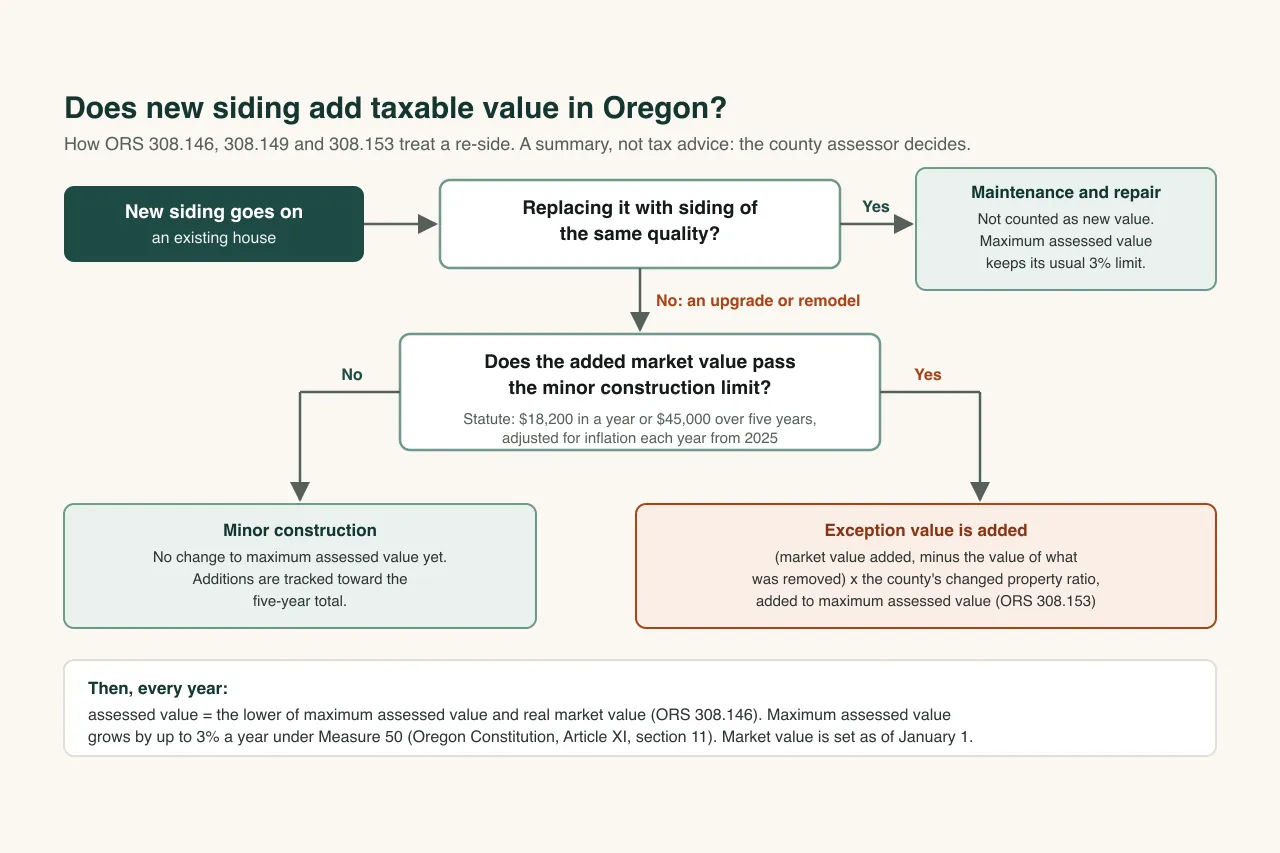
New siding can raise what a house is worth, mainly by replacing a wall a buyer would otherwise discount. In the 2025 Cost vs. Value report, fiber cement and vinyl re-siding both ranked in the top ten of 28 projects for cost recovered at resale. In Oregon, a like-for-like re-side usually counts as maintenance and repair, which the law keeps out of new taxable value.
In short:
- Resale. Siding replacement is one of the better-returning remodeling projects in the national averages. Averages are not an appraisal of your house.
- Condition. Appraisers and lenders grade deferred maintenance, so a failing wall can count against a sale.
- Property tax. Same-quality replacement is maintenance. An upgrade over the minor construction limit can add “exception” value to your maximum assessed value.
- Ask first. Your county assessor applies these rules, and this is not tax advice.
This guide covers resale and property tax for a Portland-area house. What a re-side involves is on the siding replacement page, and what it costs on the siding cost guide.
Does new siding increase home value?
The most-quoted source is the Cost vs. Value report, published each year by Zonda. Its 2025 edition, released September 18, 2025, compares the cost of 28 remodeling projects with an estimate of the value each adds at sale. Zonda says the resale estimates come in part from surveys of real estate professionals, with costs from its work with Verisk’s XactRemodel estimating tool (Zonda, 2025 Cost vs. Value).
In the national results, fiber cement siding replacement ranked fourth of the 28 projects for cost recovered and vinyl siding replacement ranked sixth. Eight of the top ten were exterior replacements, the projects a buyer sees from the street.
Portland is not reported on its own in the 2025 report; this site uses its Pacific region averages. For re-siding about 1,250 square feet of wall with trim, the report puts the job cost at $22,555 in factory-primed fiber cement and $18,507 in vinyl (Remodeling 2025 Cost vs. Value Report (www.costvsvalue.com), Pacific region. © 2025 Zonda Media, a Delaware Corporation. Complete data from the Remodeling 2025 Cost vs. Value Report can be downloaded free at www.costvsvalue.com.). Those are regional averages for one house size, not quotes, and the report’s resale figures are estimates, not sale prices.
Three things those averages cannot tell you:
- What the old wall was doing to the price. A buyer or appraiser who sees soft boards, peeling paint or water stains prices in the repair. A re-side on that house removes a visible defect; on a house whose siding was sound, it changes much less.
- What else is wrong. New siding over a wall with water damage behind it is a short-lived improvement. A re-side is the time to rebuild the house wrap, window flashing and drainage behind it.
- Your street. Resale estimates are averages. A local agent’s comparable sales say more about one house than any national table.
Where siding shows up in an appraisal
Lenders care about condition, and siding is one of the first things an appraiser sees. Fannie Mae’s Selling Guide (topic B4-1.3-06) rates the condition of a house from C1 to C6:
- C4: some minor deferred maintenance and physical deterioration from normal wear and tear.
- C5: obvious deferred maintenance, in need of some significant repairs.
- C6: damage or deferred maintenance severe enough to affect the safety, soundness or structural integrity of the house.
A loan on a C6 property is not eligible for sale to Fannie Mae until the problems are repaired to at least C5, and the appraisal is made subject to those repairs. Siding that has let water into the framing can move a house toward the bottom of that scale. That is the strongest financial case for fixing a failing wall before listing, whatever the national resale averages say. The dry rot guide covers what Oregon’s seller disclosure form asks about rot and moisture, and how FHA and VA loans treat it.
Fiber cement or vinyl: which adds more?
In the 2025 national figures, fiber cement recovered a larger share of its cost than vinyl, and in the Pacific region it also cost more to install. Both facts point the same way for resale: fiber cement costs more up front and the report expects buyers to pay for more of it. Neither tells you which suits your house. Historic district rules, the style of the house and how long you plan to stay matter more; the materials comparison on the services page and the fiber cement and vinyl pages go through the trade-offs.
Will new siding raise my property taxes in Oregon?
Usually not by itself, but it depends on what the county assessor decides the project was. Oregon taxes a house on its assessed value, and since Measure 50 that value has been held apart from market value.
Three numbers matter, all defined on Multnomah County’s glossary of value terms and in ORS 308.146:
- Real market value (RMV): what the assessor estimates the property would sell for, as of January 1.
- Maximum assessed value (MAV): the greater of 103 percent of last year’s assessed value or 100 percent of last year’s MAV. The Oregon Constitution (Article XI, section 11) caps its growth at 3 percent a year.
- Assessed value (AV): the lower of RMV and MAV. This is the number the tax rate is applied to.
In much of the Portland area, assessed value sits well below market value. Washington County’s 2025-26 property tax fact sheet puts the average single-family assessed value at a little over half the average real market value. When a house is in that position, a rise in market value from new siding does not change the tax on its own: the 3 percent cap, not the market, sets the assessed value.
When a re-side adds “exception” value
The cap has exceptions. The Constitution and ORS 308.146(3) let the county recalculate MAV when a property gets new property or new improvements, among other events. ORS 308.149 defines new improvements to include “remodeling, renovation or rehabilitation,” and excludes two things:
- General ongoing maintenance and repair. Multnomah County’s glossary says this includes replacing or repairing property elements with elements of the same quality. Replacing worn lap siding with comparable siding reads like that description, though the assessor makes the call.
- Minor construction. Additions whose real market value is no more than 18,200 dollars in an assessment year, or 45,000 dollars over five years, as the statute sets them. The Department of Revenue adjusts both figures for inflation each year from 2025 (ORS 308.149(5); OAR 150-308-0160). Multnomah County’s glossary, last reviewed November 28, 2025, lists the indexed figures as 18,700 and 46,200 dollars.
A re-side that is an upgrade, part of a larger remodel, or big enough to pass the limit can be treated as an improvement. Then ORS 308.153 adds to MAV the real market value of the new improvement, reduced by the value of what was removed (the statute’s “retirements”), multiplied by the county’s changed property ratio. That ratio is the average MAV of unchanged properties divided by their average market value, and it cannot exceed 1.00. Multnomah County explains it on its estimating taxes on changed property page, which notes that the cost of the work does not necessarily equal the market value it adds, that value is measured as of January 1, and that the tax roll is certified each October. The county does not estimate taxes for a year that has not been certified.
Two details are easy to miss. Taking off old siding is itself a retirement, so a replacement can add less new value than its price suggests. And the result only adds to MAV; the tax still follows the lower of MAV and market value.

Taxes can still change without a re-side
Even with no work on the house, assessed value usually rises up to 3 percent a year, and the bill is assessed value times the tax rate, so it can move by more or less than that. Market value still matters in one way: Measure 5 limits operating taxes to 5 dollars per 1,000 dollars of real market value for schools and 10 dollars per 1,000 for general government, and taxes above those limits are reduced (“compression”), as Washington County’s fact sheet explains. For a compressed property, market value, not just assessed value, affects the bill. Whether yours is compressed is shown on the county’s records, not on this page.
Questions to ask your county assessor
Before a large exterior project, a short call or email to the assessor’s office in Multnomah, Washington or Clackamas County can settle the questions this guide cannot:
- Would replacing the siding with a similar product be treated as maintenance and repair?
- If the new siding is an upgrade, or part of a remodel, how is the added value estimated?
- What are this year’s minor construction limits?
- Is my account currently in compression?
Keep the contract, product names and any manufacturer warranty papers. They show a buyer, an appraiser or an assessor what was done and when.
Pricing your own house
The averages above describe a standard house in a region. Your number depends on your wall area, the material you choose, what turns up behind the old siding and whether trim and paint are included. The siding cost guide shows the sourced ranges, the guide to comparing siding quotes explains what a good bid itemizes, and how long siding lasts helps you judge whether your current wall is near the end of its life. When you are ready, request a siding quote and check the license of anyone you hire on the Oregon CCB license search.
This guide is general information about Oregon’s rules as published, not tax, legal or financial advice.
This page is general information, not professional advice about your specific situation. Have it assessed by a qualified professional before making decisions. Last reviewed October 26, 2026.
Start My Siding Quote
No cost and no obligation. Tell us about the house and the siding problem to get started.